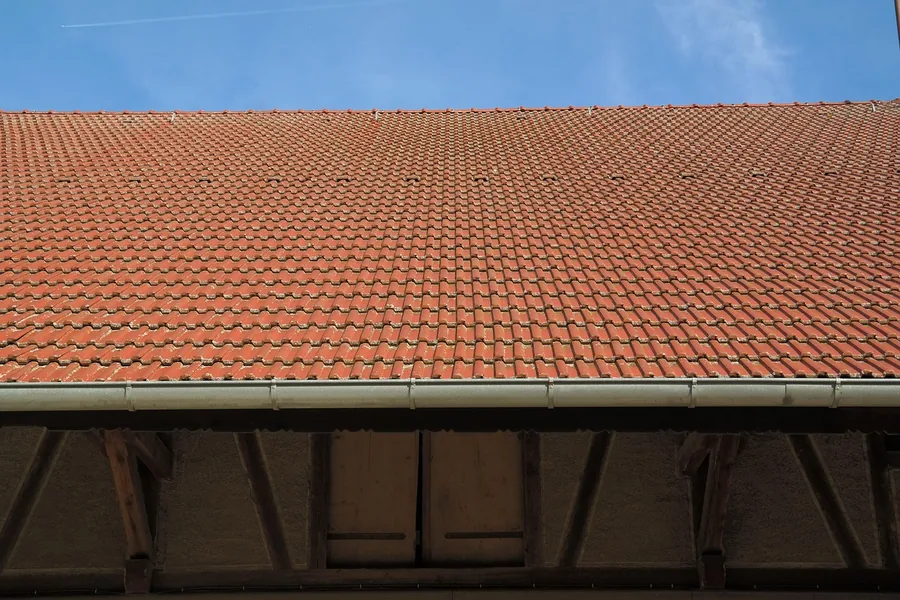
Blocked gutters cause ceiling stains in Johannesburg homes far more often than people expect. A brown ring near an outside wall, peeling paint on a cornice or a damp line along the top of a room is easily blamed on the tiles or sheets above. Yet the roof covering may be perfectly sound. The water is coming in at the edge, where gutters, fascias and barge boards are meant to carry it away.
How Water Gets In at the Edge
A gutter is designed to catch water from the roof and send it to a downpipe. When it cannot do that, the water goes somewhere else. In a Johannesburg summer storm, a large volume of water arrives in a short time, and any weakness at the edge is quickly found out. The main routes are:
- Overflow at the back of the gutter. If a gutter is blocked or sagging towards the house, water can spill over the back edge, behind the fascia and into the roof space.
- Leaking joints and end caps. Water dripping from a failed joint can run along the fascia and into the eaves.
- Rotten fascias. Once a timber fascia softens, gutter brackets loosen, the gutter tilts and the overflow problem gets worse.
- Gaps at the barge boards. On gable ends, damaged barge boards or flashings can let wind-driven rain into the roof void.
- Blocked downpipes. A downpipe blocked at its outlet backs water up into the gutter, which then overflows.
What the Stains Look Like
Edge-related stains have a recognisable pattern. They usually appear close to an outside wall, often along the line where the ceiling meets the wall, and they tend to show after heavy storms rather than light rain. A stain in the middle of a room is more likely to come from the roof covering, a valley or a flashing. A stain at the edge, especially under a section of gutter you know collects leaves, points to the gutter or fascia.
Other signs to look for from outside include tide marks or streaks on the fascia, plants growing in the gutter, gutters that dip between brackets, peeling paint or soft spots on the fascia, and water pouring over the front of the gutter during a storm.
Why Johannesburg Homes Are Affected
Many northern-suburbs properties have mature trees, so leaves, seed pods and twigs fill gutters through the year. Summer storms are intense, so gutters and downpipes have to cope with heavy flow in a short time. Older homes may have timber fascias that have been painted many times but are softening underneath. In townhouse complexes, box gutters between units can block and send water into more than one home.
Checking Safely
Do not climb onto the roof. From the ground, watch the gutters during heavy rain if you can do so safely: water pouring over the front or dripping from joints shows where the problems are. After the rain, look along the fascias for stains and along the gutters for sagging sections. Inside, check whether the ceiling stains line up with the outside wall under those sections. Photos of what you see are useful when you ask for a quote.
What the Repair Usually Involves
The repair depends on what has failed. Common work includes clearing gutters and downpipes, resetting gutters so they fall towards the outlets, adding an outlet or downpipe where a long run cannot drain fast enough, replacing leaking joints and end caps, and replacing rotten fascia or barge boards before refixing the gutter. If the ceiling has been wet for some time, check the timber behind the fascia and the top plate of the wall as well.
Once the edge is fixed, the ceiling needs time to dry before any patching or repainting inside. Repairing the ceiling before the cause is fixed only means doing it twice.
When It Is Not the Gutters
Not every stain near a wall is an edge problem. A leak at a wall flashing, a cracked tile near the eaves, or damp in the wall itself can produce similar marks. That is why the source should be checked before any repair is chosen. If the inspection shows the gutters and fascias are sound, the search moves to the roof covering and flashings.
Keeping Gutters Working
A short routine prevents most of these problems: clear gutters before the storm season starts in spring and again after the leaves fall in autumn, check that every downpipe drains freely, and look along the fascias once a year for soft spots or peeling paint. In complexes, put box gutters on the maintenance schedule rather than waiting for a leak.
Downpipes and Where They Discharge
Look at where each downpipe ends. One that empties against a wall, onto paving that falls towards the house or into a blocked drain can cause damp problems at ground level that are easily confused with roof leaks. Making sure each downpipe discharges away from the building, into a clear channel or drain, completes the job that the gutter starts.
For the repair itself, see gutters, downpipes and fascias, or send us photos of the stain and the roof edge above it. We do this work across Johannesburg and the northern suburbs.